Documents

  in 

  
  Advanced search
Change font size to larger    Register    Login  
Home Page
Nature Directory
Visitor Resources

The social impact of ebola: the case of Kellé district, Congo

Earth > All Themes > People > Relation to Nature > Africa > Congo (Republic of) > Cuvette-Ouest Region

Bushmeat hunting is a major activity in the current socio-economic context, and the disease is upsetting the traditional relationships with the natural environment as well as the social fabric.


Bush meat

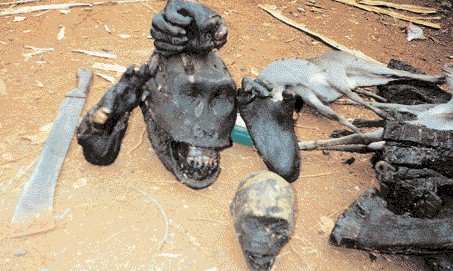
The outbreak of the disease has occurred in a socio-economic context where bushmeat hunting is an essential activity. In spite a repeated warnings, many populations of central Africa still eat gorilla and chimpanzee meat. Customary traditions do not include provisions against the killing of primates, or against coming in contact with and eating animals found dead or sick. How to resist the temptation of meat so easily gained? As a result the contact with animals carrying the virus is at the root of many circuits of contagion.

The people who cut up the carcasses and women who prepare fresh meat are the first victims, not to mention greedy or hungry individuals who cannot resist grilling bits of viscera while the carcass is being cut up. Also to be mentioned is the ritual eating of specific organs, heart or liver for instance, by well defined members of groups such as hunters. As a result public health action needs to focus primarily on prevention as well as on the disruption of the circuits of contagion.

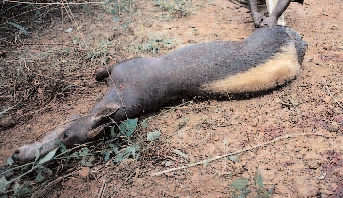
Killed cephaloph

Initiatives of sanitary policing are taken at the national and regional levels, by isolating the threatened area, withholding people’s rights to travel, controlling automobile traffic, closing schools, forbidding all meetings of any kind: political, religious, musical, sport, etc… Movements from village to village are theoretically forbidden, be they for family purposes, business or the quest for medical diagnosis or cure: but how to control the pedestrian movements of people who have known their surroundings since their childhood and when family networks spread from city to forest?

It is officially forbidden to hunt great apes (chimpanzees and gorillas) and to enter into contact with any animal found dead. To eat the meat of other game animals (antelopes, monkeys, cephalophs, etc) as well as to sell it on markets are either forbidden or discouraged. In this latter case however the boundary is hardly clear-cut thanks to scientific uncertainties: some non-carnivorous animals occasionally eat carcasses that may be contaminated. The meat of domesticated animals and fish are promoted, but in these societies of hunters-gatherers-farmers the available stocks are either limited or seasonal: hunting provides the main source of meat and proteins. The actions of collecting it, sharing it, preparing it and eating it are among the main factors of social organisation.

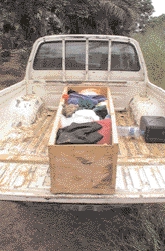
Personal belongings saved from fire

Because of the deadly risks conveyed by the of the sick or dead body’s contaminated fluids, all physical contacts in their customary social framework, be they ordinary or extra-ordinary, must be radically reconsidered if not forbidden. In everyday life all inter-personal physical contacts, including at greeting time, are prohibited.

Contaminated individuals are barred from approaching or being in contact with healthy individuals: a strict control of the dispersion of their body fluids is attempted, including perspiration, expectorations and nasal secretions.

Sick individuals are supposed to be isolated in a hospital unit or, if this is not available, at home and supplied with gloves and a very small amount of bleach (sodium hypochlorite).

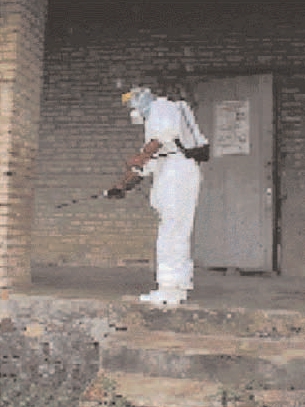
In theory contaminated bodies and body fluids and dead bodies should be approached only by specially trained (initiated?) individuals, dressed in special white outfits, wearing gloves and a mask covering the face and eyes.

Contagion and the extraordinary death rate it causes, in a context of medical powerlessness, result in a grave disturbance of the normal social relationships, as well as the relationships with the natural, biological and fantasmagorical ecosystem.

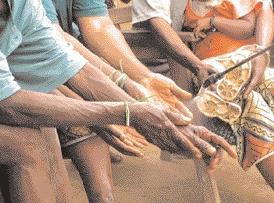
Disinfection underway

Because physical contacts with the sick and their fluids must be avoided, the expression of solidarity or affection is no longer possible. Both the rites surrounding death and the relations between the spirits of the dead and those of the living are upset by the ban on handling and burying the dead in the customary manner.

The repeated occurrence of deaths, an epidemiological surveillance based on lists of names of sick or at risk individuals, the measures of avoidance and quarantine, decontamination rituals carried out by socio-medical staff dressed like extra-terrestrials, are at the root of rumours and reactions of fear in the population.

In opposition to the aims pursued, consequences resulting in a further spreading of the disease can be obtained, such as individuals and families moving away from places of death and joining other family groups. During epidemic outbreaks any person showing signs of illness is considered as potentially contaminated and contaminating, so that medical structures are deserted.

The recommended prevention goes against habits and beliefs: essential protein resources are suspected or forbidden, physical contacts with the patients banned, also alteration of the funerary rites, restriction of the freedom to travel, and primacy given to the virological model over the indigenous model.

Demonstration of disinfectant spraying

The benefits of a bio-medical action based on virological models, which ignore the interpretation given to misfortune by indigenous models, cannot be directly perceived because of the time lag between intervention and results. In consequence African knowledge as well as other models of misfortune interpretation and a broad spectrum of social usage of misfortune are all left free to operate. The scientific (not to say white) point of view then becomes one element of knowledge among many, competing not only with “ignorance”, but with the knowledge and the powers of the African sciences and of the sacred books. Four local teachers, accused of being involved in “mistik” (mystical) practices combining the Nzobi and Rose-Croix cults, were lynched by a large crowd (in which many students were part) stirred up by local traditional practitioners and, no doubt, their political opponents: they were part of the PCT, the winning party at the latest elections!

The four murdered individuals were members of the Rose-Croix cult which seems to stand in opposition with the rest of the population, especially by asserting that the suffering imposed to animals in general and the “most evolved among them” are the cause of diseases. They were accused of combining Rose-Croix activities and “mistik” prayers into occult practices, with the aim of using witchcraft to kill some people, in order to gain power and wealth.

AUTHORS:
Alain EPELBOIN,
médecin anthropologue
Centre national de la recherche scientifique,
Muséum national d’histoire naturelle, Paris,
epelboin@mnhn.fr
Pierre FORMENTY,
épidémiologiste OMS Genève
Avec la collaboration de l'USM écoanthropologie
et ethnobiologie, MNHN CNRS Paris
Serge BAHUCHET
écoanthropologue, MNHN CNRS Paris

Article reproduced from Canopée No 24, July 2003 (link provided below).

Translation from English OEP/NC


Author: 
Reproduced by OEP from: (as indicated above)  

Creation/last update: 28 February 2005

Recommended websites or webpages :

This article in Canopée No 24 online - Click to access

Canopée online (index) - Click to access

ECOFAC website - "Conservation and Rational Use of the Forest Ecosystems of Central Africa"

 
Geographic Navigation with Google Earth
To use this you need to have the Google Earth client installed on your computer(free download)
 
Where on earth is this document?   
 locate in Google Earth  (this document only)
or explore the Open Earth Project in Google Earth   
 show all OEP documents in Google Earth
 
Related Locations for
current theme: Relation to Nature
Sangha Region


Copyright NC © 2003 - 2008
All Rights Reserved